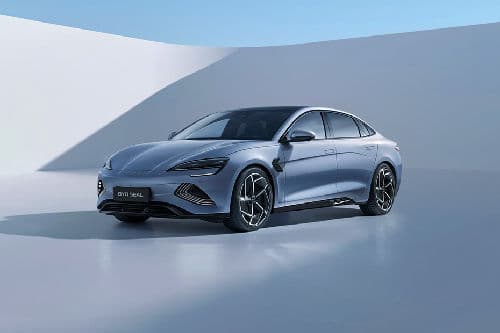
Electric Vehicle · 2025
BYD Seal Price Philippines 2026
₱1,998,000 to ₱2,548,000

66
Expressway Score
EV
Electric
8
Airbags
Class 1
Toll Class
Expressway Score
66/100GOOD
Score Breakdown
Overview
The 2025 BYD Seal is a fully electric performance sedan that represents the cutting edge of EV technology available in the Philippines, featuring BYD's proprietary Blade Battery for enhanced safety and up to 580 km of NEDC range on a single charge. The BYD Seal price Philippines ranges from ₱1,998,000 for the Advanced variant with a single rear motor producing 201 hp, to ₱2,548,000 for the Performance AWD variant that unleashes 530 hp and 670 Nm through dual motors, making it the most powerful sedan in the Philippine market regardless of fuel type. Both variants come standard with a comprehensive ADAS suite including adaptive cruise control, lane centering assist, and autonomous emergency braking, plus 8 airbags, the highest count on our list. The Blade Battery's cell-to-body design lowers the center of gravity for sports car-like handling while providing exceptional thermal safety compared to traditional lithium-ion packs. The Seal competes in a unique space against both premium gasoline sedans like the Honda Civic RS and the growing EV segment, appealing to tech-forward professionals who want zero-emission driving with performance that leaves combustion cars behind.
This overview is AI-assisted based on manufacturer specifications and Philippine market data. Specs and pricing are sourced from official dealership listings. Editorial Policy
Expressway Driving Review
The BYD Seal is arguably the most impressive expressway vehicle in the Philippine market when it comes to pure driving experience. Instant electric torque means merging onto NLEX, SLEX, or Skyway requires zero planning, press the accelerator and the Seal surges forward with no turbo lag, no CVT delay, and no gear changes. The Performance variant's 530 hp and 670 Nm provide the fastest overtaking capability of any vehicle on this list by a massive margin. Full ADAS with adaptive cruise control and lane centering creates a semi-autonomous highway driving experience on straight stretches of TPLEX and SLEX, dramatically reducing driver fatigue on long trips. The cabin is whisper-quiet at any speed since there is no engine noise, only faint tire and wind noise above 100 km/h. Operating costs on expressways are transformatively low: charging at home costs approximately ₱1.00-1.50 per kilometer vs ₱4.00-5.00/km for gasoline sedans, meaning a Manila-to-Baguio trip costs roughly ₱250-375 in electricity vs ₱1,000-1,250 in gasoline. The 580 km NEDC range (approximately 460-490 km real-world) covers any Philippine expressway route with margin to spare. As a Class 1 vehicle, toll costs remain standard. The only expressway concern is the 120mm ground clearance, the lowest on our list, which requires caution on steep toll plaza approaches and uneven road transitions.
This review is AI-assisted based on manufacturer specifications and Philippine market data. Specs and pricing are sourced from official dealership listings. Editorial Policy
Driver Assistance Features
BYD Seal 2025 Price & Variants
| Variant | Price | Transmission | Fuel |
|---|---|---|---|
| Advanced | ₱1,998,000 | AT | electric |
| Performance AWD | ₱2,548,000 | AT | electric |
Specifications
Engine & Performance
- Power
- 201 hp (Advanced) / 530 hp (Performance)
- Torque
- 310 Nm / 670 Nm
- Transmission
- Single-speed
- Fuel Type
- electric
Dimensions
- Length × Width × Height
- 4800 × 1875 × 1460 mm
- Wheelbase
- 2920 mm
- Ground Clearance
- 120 mm
- Kerb Weight
- 2,015 kg
- Trunk Capacity
- 400L
Fuel Efficiency
The BYD Seal is fully electric. Zero fuel costs for expressway commuting. Approximate electricity cost: ₱1.50/km vs ₱4-5/km for gasoline vehicles.
Pros & Cons for Expressway Driving
Pros
- ✓Zero fuel cost for expressway commuting, approximately ₱1.00-1.50/km vs ₱4.00-5.00/km for gasoline
- ✓Full ADAS suite standard on all variants, adaptive cruise, lane centering, AEB
- ✓8 airbags, highest safety equipment count on our entire list
- ✓580 km NEDC range covers any Philippine expressway route including Manila to Baguio round trip
- ✓530 hp and 670 Nm on Performance AWD, most powerful sedan in the Philippines
- ✓Whisper-quiet cabin at highway speeds, no engine noise, only faint tire/wind noise
- ✓Blade Battery technology provides industry-leading thermal safety and durability
Cons
- ✗120mm ground clearance, lowest on our list, requires caution at toll plazas and speed bumps
- ✗Philippine EV charging infrastructure is still developing, limited fast chargers outside Metro Manila
- ✗Heavy at 2,015 kg, affects handling feel compared to lighter gasoline sedans
- ✗Limited BYD service center network in the Philippines, fewer than 15 locations
- ✗Long-term battery replacement cost uncertainty for Philippine climate conditions
- ✗Higher purchase price than comparable gasoline sedans like the Civic RS or Mazda3
This analysis is AI-assisted based on manufacturer specifications and Philippine market data. Specs and pricing are sourced from official dealership listings. Editorial Policy