Number Coding Today: Schedule, Hours, Window and Fines (2026)
Number coding keeps a car off Metro Manila's main roads on one weekday a week, chosen by the last digit of its plate. The MMDA enforces it from 7:00 to 10:00 in the morning and 5:00 to 8:00 in the evening, Monday to Friday. Makati runs it straight through from 7:00 AM to 7:00 PM. The card below tells you whether your plate is coded today. The rest of the page covers the schedule, the window hours, the cities that differ, who is exempt, the fine, and where coding stops on the expressways.

Number Coding Schedule
Check Your Day
See the full weekly schedule below to find your plate restriction.
Am I Coded Today?
See the schedule table below to check if your plate is restricted today.
Number coding keeps a car off Metro Manila's main roads on one weekday a week, chosen by the last digit of its plate. The MMDA enforces it from 7:00 to 10:00 in the morning and 5:00 to 8:00 in the evening, Monday to Friday. Makati runs it straight through from 7:00 AM to 7:00 PM.
The card below tells you whether your plate is coded today. The rest of the page covers the schedule, the window hours, the cities that differ, who is exempt, the fine, and where coding stops on the expressways.
Number Coding Schedule 2026: Which Plates Are Coded Each Day
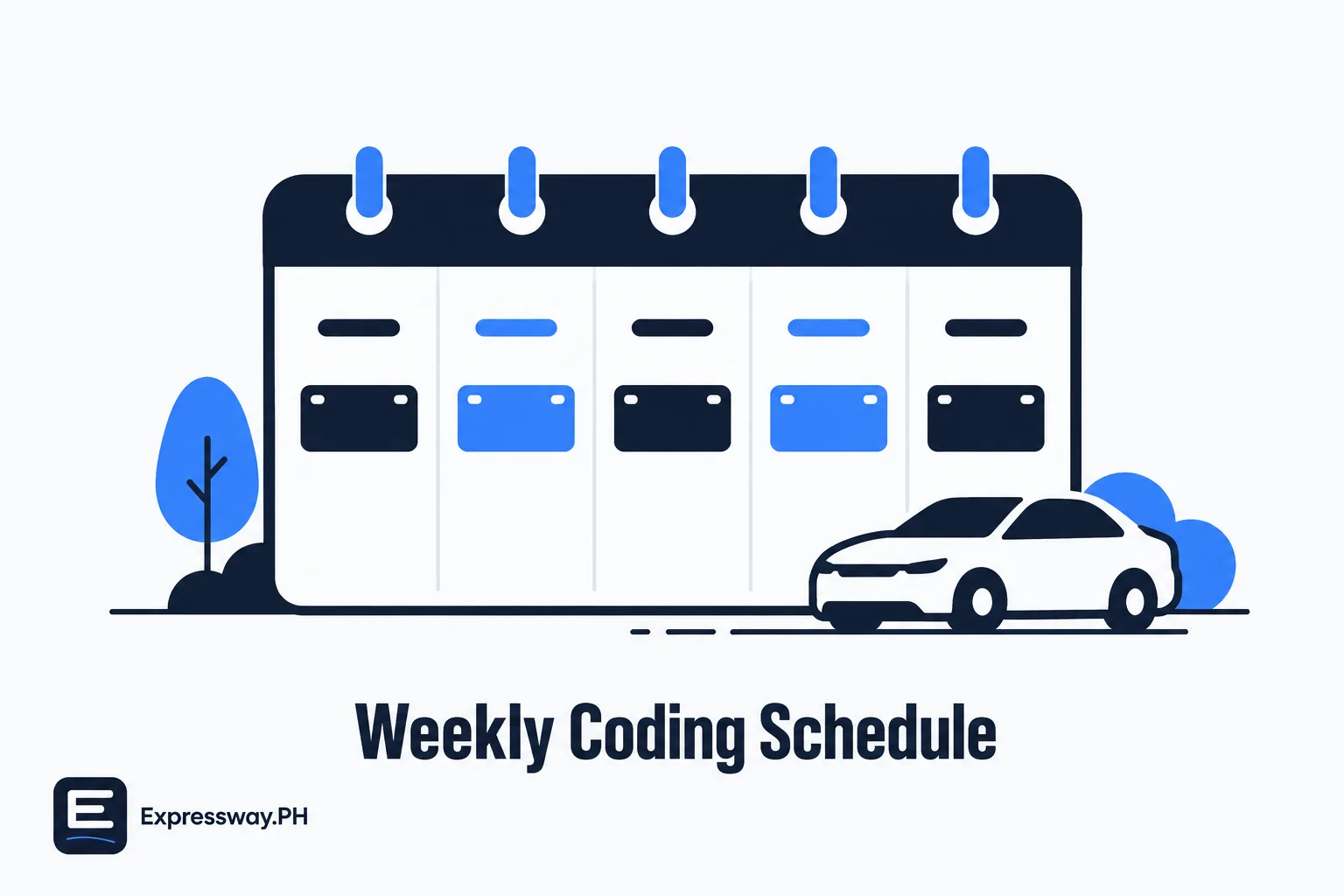
Two plate endings are coded on each weekday. Monday is 1 and 2, Tuesday 3 and 4, Wednesday 5 and 6, Thursday 7 and 8, Friday 9 and 0.
The rule follows the plate, not the driver or the city of registration. A car from Laguna with a plate ending in 5 is coded in Metro Manila every Wednesday.
Saturday and Sunday have no coding anywhere in the MMDA scheme. The table below is the full week.
- 1
Monday
Plates ending in 1 and 2 are coded from 7:00 to 10:00 AM and 5:00 to 8:00 PM
- 2
Tuesday
Plates ending in 3 and 4 are coded from 7:00 to 10:00 AM and 5:00 to 8:00 PM
- 3
Wednesday
Plates ending in 5 and 6 are coded from 7:00 to 10:00 AM and 5:00 to 8:00 PM
- 4
Thursday
Plates ending in 7 and 8 are coded from 7:00 to 10:00 AM and 5:00 to 8:00 PM
- 5
Friday
Plates ending in 9 and 0 are coded from 7:00 to 10:00 AM and 5:00 to 8:00 PM
Number Coding Hours: 7:00 to 10:00 AM and 5:00 to 8:00 PM
The MMDA enforces number coding in two blocks on weekdays: 7:00 to 10:00 in the morning and 5:00 to 8:00 in the evening. The clock is exact. A coded car on EDSA at 7:02 AM gets a ticket; the same car at 10:01 AM does not.
The two blocks apply on every national road the MMDA covers, EDSA, C-5, Commonwealth, Roxas Boulevard and the rest. City streets follow the city's own ordinance, which in most of Metro Manila copies the MMDA hours.
Makati is the one city with a single block, 7:00 AM to 7:00 PM. If your route crosses Makati, plan around the longer hours, not the MMDA ones.
Number Coding Window Hours: 10:01 AM to 4:59 PM
Window hours are the gap between the two blocks, 10:01 AM to 4:59 PM, when a coded car may use MMDA roads freely. The overnight gap, 8:01 PM to 6:59 AM, works the same way. The MMDA restates both in every Expanded Number Coding advisory.
Most coded drivers plan the day around the window: leave after 10:00 AM, be off the covered roads before 5:00 PM. A 4:45 PM departure from Quezon City to Makati does not fit; the evening block starts before you arrive.
Makati has no window. Its 7:00 AM to 7:00 PM block runs straight through, so the window only helps you until you cross into Makati.
Is There Number Coding Today? Check Your Plate
Yes on any weekday that is not a holiday. The card at the top of this page shows today's two coded digits, and the checker below it takes your last digit and gives a one-line answer.
If today is a regular or special non-working holiday, the MMDA suspends coding automatically and the card says so. Weather suspensions are announced the same morning on the MMDA's Facebook and X accounts; the holiday section further down explains how to check.
If your plate is coded, the window hours above are your working day: 10:01 AM to 4:59 PM on MMDA roads.
Makati Number Coding: 7:00 AM to 7:00 PM, No Window Hours
Makati enforces its own ordinance: 7:00 AM to 7:00 PM on weekdays, with no window hours, on every road inside the city. Ayala Avenue, Gil Puyat (Buendia), Chino Roces and the Makati stretch of EDSA all count.
The plate schedule is the same as the MMDA's, so a plate ending in 1 or 2 is coded all day Monday in Makati. Motorcycles are included in Makati, which is not the case under the MMDA scheme.
The fine is a ladder: ₱1,000 for a first offence, ₱2,000 for a second and ₱5,000 for a third within a year. The elevated Skyway above Makati is a national toll road and is outside the ordinance; the ramps that drop you onto Makati streets are inside it.
| Violation | 1st Offense | 2nd Offense | 3rd Offense |
|---|---|---|---|
| Makati number coding violation (offences within one year) | ₱1,000 | ₱2,000 | ₱5,000 |
Number Coding by City: Which Cities Follow the MMDA Hours
The MMDA enforces coding on national roads in every Metro Manila city, so EDSA is coded in Pasay the same way it is coded in Quezon City. What changes from city to city is the ordinance for city streets.
Most cities copy the MMDA hours, 7:00 to 10:00 AM and 5:00 to 8:00 PM with the daytime window. Makati is the exception with its 7:00 AM to 7:00 PM block. A few cities do not enforce coding on their own streets at all; that never lifts the MMDA rule on the national roads that run through them.
Before you rely on a "no coding in my city" claim, check two things: whether the road you are on is a national road, and what the city traffic office published this year. This page will carry a verified city-by-city table once each ordinance is confirmed.
Number Coding Exemptions: Who Can Drive on a Coding Day
Electric vehicles, full hybrids and plug-in hybrids are exempt under the Electric Vehicle Industry Development Act, RA 11697, Section 25. The exemption runs for eight years from the law's effectivity in 2022, and the MMDA told its enforcers not to ticket them. Mild hybrids are not covered; the Department of Energy said so in 2025.
The MMDA scheme also leaves out public utility vehicles, motorcycles, government vehicles, fire trucks, ambulances, garbage trucks, fuel trucks, media vehicles and trucks carrying essential or perishable goods. Vehicles carrying a person with disability can apply for an MMDA exemption pass, and doctors and medical first responders can apply for a pass for emergency response.
Two things to know before you count on an exemption. It is granted by vehicle type or by an approved pass, never by plate colour. And ad hoc exemptions exist: in August 2026 the MMDA exempted bar examinees for the exam dates.
- 1
Check the vehicle type first
EVs, full hybrids and plug-in hybrids need no pass; the LTO registration class is the proof. Mild hybrids are not exempt.
- 2
Apply for a pass if you qualify
PWD and medical-responder passes come from the MMDA (Traffic Adjudication Division for PWD). Bring the OR/CR, a valid ID and the proof for your category.
- 3
Display the pass
An approved pass is shown on the windshield. Without it, an enforcer on EDSA has no way to know you qualify.
Is There Number Coding on Skyway, SLEX, NLEX and EDSA?
No on the toll roads, yes on EDSA. Skyway, SLEX, NLEX, NAIAX, CAVITEX, CALAX, SCTEX, TPLEX, MCX and STAR Tollway are toll roads under the Toll Regulatory Board, outside the MMDA scheme. The Skyway operator's own advisory says it plainly: there is no number coding on the Skyway.
EDSA, C-5, Commonwealth and the other national roads are where the scheme lives. Coding starts again the moment you leave a toll road onto them.
The catch is the ramp. Leaving SLEX at Magallanes at 5:15 PM on a Wednesday puts a plate ending in 5 or 6 onto Makati streets during Makati's block. Entering NLEX at Balintawak at 7:30 AM on a Monday means a coded 1 or 2 plate drove EDSA or A. Bonifacio to get there. Plan the first and last kilometre, not just the toll road.
Number Coding Violation Fee and How to Pay
An MMDA ticket for number coding is ₱300. City tickets on city streets follow the city ordinance, which goes up to ₱500 in some cities and to ₱1,000, ₱2,000 and ₱5,000 in Makati.
The enforcer issues a ticket on the spot with the violation, the time, the place and the enforcer's name. You pay an MMDA ticket at MMDA offices or its accredited payment channels, and a city ticket at that city's treasurer. Pay within the period printed on the ticket; an unpaid ticket surfaces when you renew the LTO registration.
Keep the receipt. If the same plate is ticketed again inside a year in Makati, the receipt is what shows it is a second offence and not a third.
| Violation | 1st Offense | 2nd Offense | 3rd Offense |
|---|---|---|---|
| MMDA ticket on a national road | ₱300 | ₱300 | ₱300 |
| City ticket on a city street (most cities) | up to ₱500 | per ordinance | per ordinance |
| Makati City | ₱1,000 | ₱2,000 | ₱5,000 |
- 1
Read the ticket
It names the issuer (MMDA or a city), the violation and the amount. That decides where you pay.
- 2
Pay at the issuer
MMDA tickets at MMDA offices or its accredited channels; city tickets at the city treasurer. Keep the official receipt.
- 3
Clear it before LTO renewal
Unpaid tickets are flagged when the vehicle registration is renewed.
Number Coding Outside Metro Manila: Baguio, Cebu, Davao
Baguio has its own scheme under Ordinance 001, Series of 2003: weekdays, 7:00 AM to 7:00 PM, inside the city's coding zones around the central business district. The plate-to-day pattern matches Metro Manila's. The city suspended it from 8 to 24 April 2026 during the fuel-driven transport shortage, then brought it back for private cars while jeepneys stayed exempt until 27 May.
Cebu City suspended its number coding scheme and has not brought it back. Davao City has never had one; a councillor proposed it in 2025 and it remains a proposal.
Laguna, Bulacan, Pampanga, Rizal and Subic have no province-wide scheme. What you meet there is the MMDA rule again once you re-enter Metro Manila on a national road.
How to Avoid a Number Coding Ticket
Know your day and set two phone alerts on it: 6:30 AM and 4:30 PM. Those two reminders prevent most tickets.
On your coding day, move inside the window, 10:01 AM to 4:59 PM, or stay on toll roads and choose an exit outside Metro Manila or after 8:00 PM. An RFID sticker makes the toll-road plan practical; it does not exempt you from coding on the ramps.
If you must be on EDSA at 8:00 AM on your day, the options are a ride-hailing car, a carpool in a non-coded car, or a work-from-home day. A ₱300 to ₱1,000 ticket is the price of guessing wrong.
Is Number Coding Suspended Today? Holidays and Weather
The MMDA suspends coding automatically on regular and special non-working holidays. In 2026 that has included Eid'l Fitr on 20 March, Holy Week from 1 to 3 April, Labor Day, Eid'l Adha on 27 May, Independence Day and National Heroes Day on 31 August. The Christmas run was 23 to 25 December 2025 and 29 December to 2 January 2026.
Weather suspensions are separate. When a typhoon or flooding closes roads, the MMDA announces the suspension the same morning, sometimes mid-morning, on its Facebook and X accounts and through the news wires.
The card at the top of this page reads the holiday calendar. For a weather day, check the MMDA's accounts before you leave; the suspension is not in force until they post it.
- 1
Holiday: assume suspended
Regular and special non-working holidays suspend coding without a separate announcement.
- 2
Weather: wait for the post
The MMDA posts weather suspensions on Facebook and X, usually before 7:00 AM but sometimes later in the morning.
- 3
Long weekend: expect volume
Suspension days are heavier on EDSA and the expressway entries, not lighter.
What Happens When You Are Caught
An enforcer stops you, asks for your licence and registration, and issues a ticket that records the violation, the time, the place and the enforcer's name and number. Signing it acknowledges receipt; it does not admit the violation.
MMDA enforcers work the national roads; city enforcers work city streets. The ticket tells you which one stopped you, and that decides the fine and where to pay.
Photograph the ticket and your position if you intend to contest it. A dashcam clip with a timestamp is the strongest evidence you can bring.
How to Contest a Number Coding Ticket
File a written contest with the issuer named on the ticket: the MMDA's Traffic Adjudication Division for an MMDA ticket, or the city's traffic adjudication office for a city ticket. Bring the ticket, your licence and registration, and your evidence.
Evidence that wins: a timestamped dashcam clip showing you inside the window, a toll receipt showing you were on the expressway at the time, or an exemption pass that was displayed and not read. A story without a timestamp rarely does.
If the contest is denied you pay the fine as issued. If it is upheld the ticket is voided and nothing attaches to the plate.
- 1
Contest with the issuer
MMDA tickets go to the MMDA Traffic Adjudication Division; city tickets to that city's adjudication office.
- 2
Bring the paper
The ticket, your licence, the OR/CR and any timestamped evidence.
- 3
Get the decision in writing
A voided ticket should show as cleared before your next LTO renewal.
Know Your Toll Before You Go
Plan your trip budget with exact toll fees and fuel cost estimates.
Try the Toll CalculatorFrequently Asked Questions
Is there number coding today?
What time is coding in Metro Manila?
What are the number coding window hours?
Until what time is coding in Manila?
How much is the number coding violation fee?
Is there number coding on Skyway?
Is there number coding on EDSA?
What is number coding in the Philippines?
Are electric cars and hybrids exempt from number coding?
Is Grab exempted from coding?
Is number coding suspended on holidays?
What is Makati number coding?
Is there number coding in Baguio?
What is a red plate number in the Philippines?
Can I use RFID to avoid number coding?
Related Pages
Traffic Violations
Road Rules
Public Transit
Expressways
Related Guides
LTO Violations and Penalties 2026: Complete Official List of Fines
LTO fines did not increase in 2026. The schedule in force is still Joint Administrative Order 2014-01, plus the fines written into the special laws on drunk driving, phone use, helmets, seatbelts and child seats. What changed on 9 January 2026 is procedure: your licence is no longer taken at the roadside, you get 15 working days to pay, and the licence goes on alarm in the LTO system until you do. Every amount below is copied from the issuance or the law, with the source named per section.
No Contact Apprehension: How to Check Violations Online (2026)
No contact apprehension uses cameras and sensors to catch traffic violations without stopping motorists, then sends notices to registered vehicle owners. The LTO Portal, MMDA app, and local government websites now let you check pending violations online before they escalate into license suspension or registration renewal blocks.