Marilao ↔ Balintawak
Historical preset: ₱85 each direction; estimated 22 km each direction.
₱85 corroborated in reporting on January 2026 tariffs; 22 km is an inherited estimate. Current primary review pending.
Inspect source / verification targetExpressway.PH · The Manila Tax series · Cost explainer
One way. There and back. Your month.
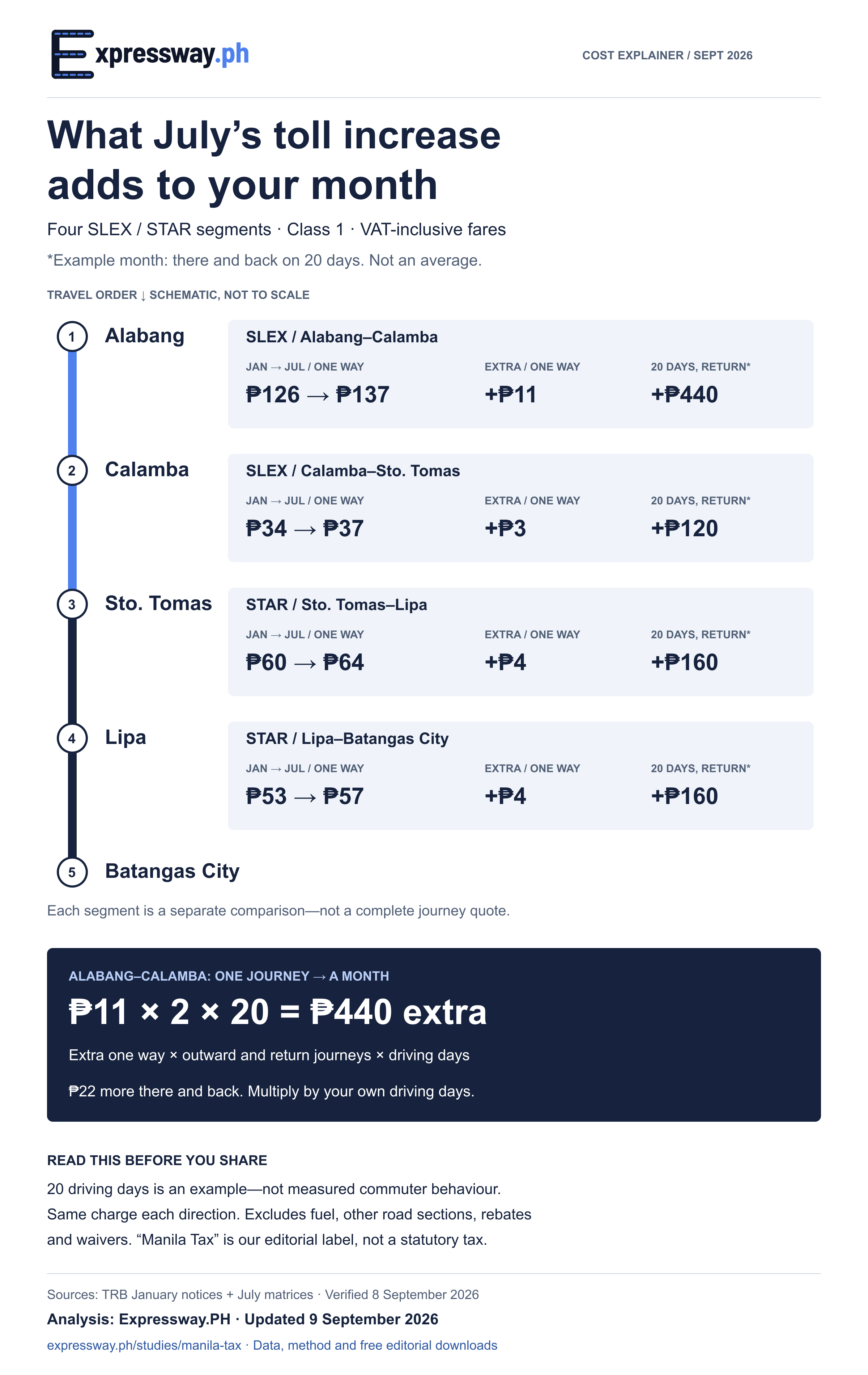
Alabang–Calamba’s Class 1 toll increased by ₱11 one way on 1 July 2026. That means ₱22 more for a return journey. Here is how that change affects different driving schedules, with TRB’s January and July fares shown side by side.
“Manila Tax” is our shorthand for recurring driving expenditure, not a statutory tax. This page explains a dated toll change; it does not measure the average Filipino commuter’s spending. Updated 9 September 2026.
TRB’s Class 1 toll for Alabang–Calamba rose from ₱126 to ₱137 per one-way journey on 1 July 2026. A return journey therefore adds ₱22 compared with January, assuming the same charge in both directions.
If you drive there and back on 20 days in a month, the increase adds ₱440 to that month’s toll bill. That is an example schedule, not a measured average. Fuel and other toll sections are extra.
| Journeys | January rates | July rates | Extra toll |
|---|---|---|---|
| One way | ₱126 | ₱137 | ₱11 |
| There and back | ₱252 | ₱274 | ₱22 |
| There and back on 20 days | ₱5,040 | ₱5,480 | ₱440 |
Verified against TRB’s official tables on 8 September 2026: January SLEX notice and July SLEX matrix. The ₱440 is our calculation, not a TRB estimate of commuter spending.
This compares January and July 2026 rates, not actual household bills or every later price change. It excludes discounts and temporary waivers. Four selected segments are examined, not a national ranking.
Choose a segment and the number of days you drive there and back. One driving day means one outward journey and one return journey on that segment.
₱440 extra in tolls
₱11 extra one way × 2 journeys × 20 driving days.
For the same schedule: ₱5,040 at January rates; ₱5,480 at July rates.
20 days is an example, not an average. Class 1; January versus July 2026 rates. Assumes the same toll each way and excludes fuel, other segments, discounts and waivers.
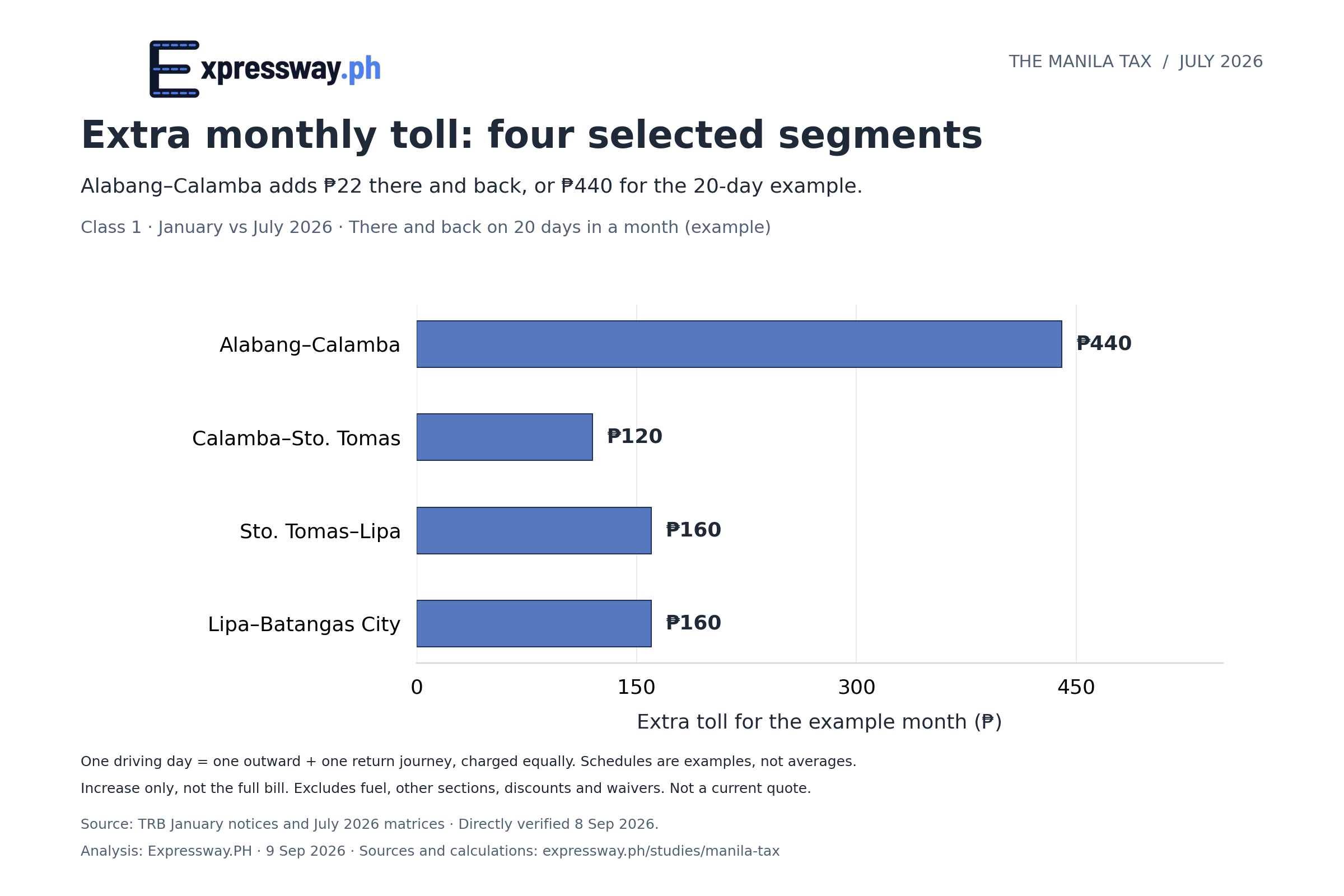
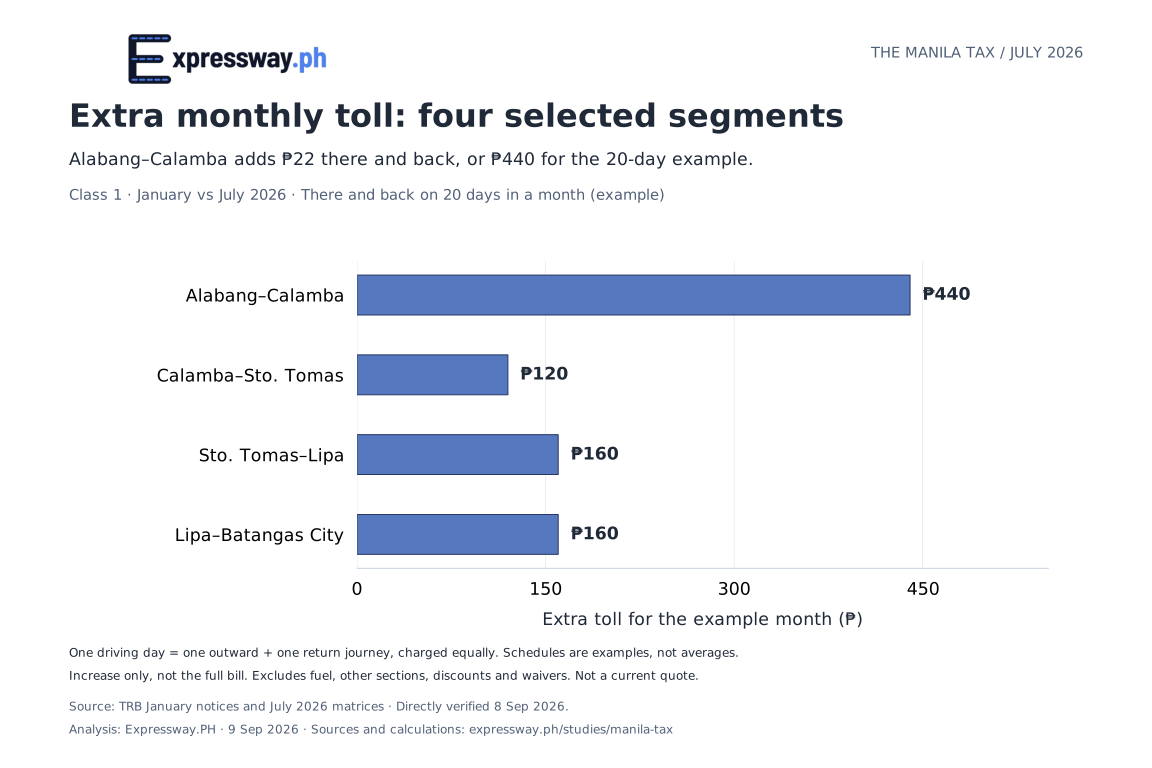
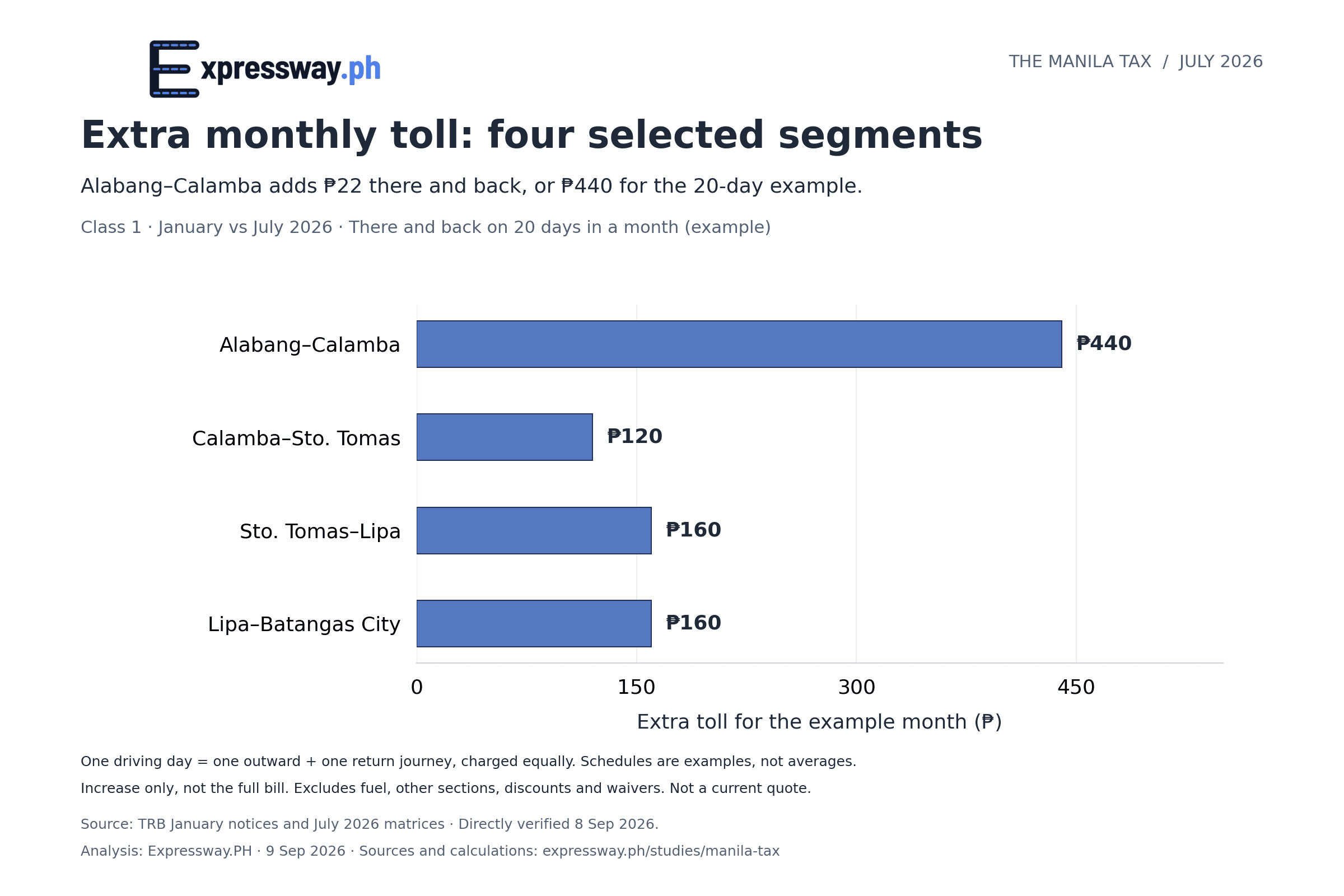
Using the same 20-day example, the extra return toll is ₱440 for Alabang–Calamba, ₱120 for Calamba–Sto. Tomas, and ₱160 each for Sto. Tomas–Lipa and Lipa–Batangas City. These are separate segment comparisons, not a complete Alabang–Batangas journey quote.
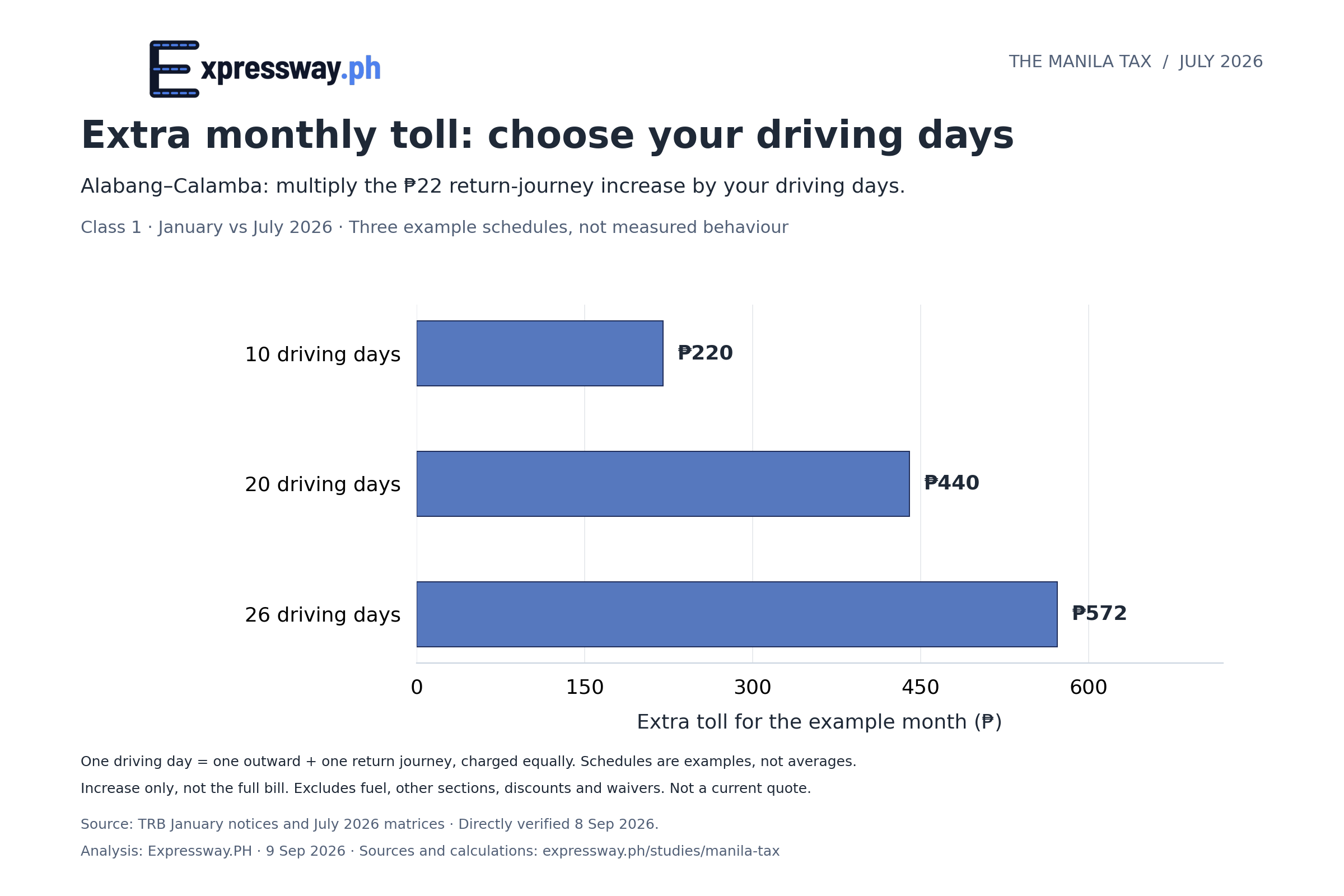
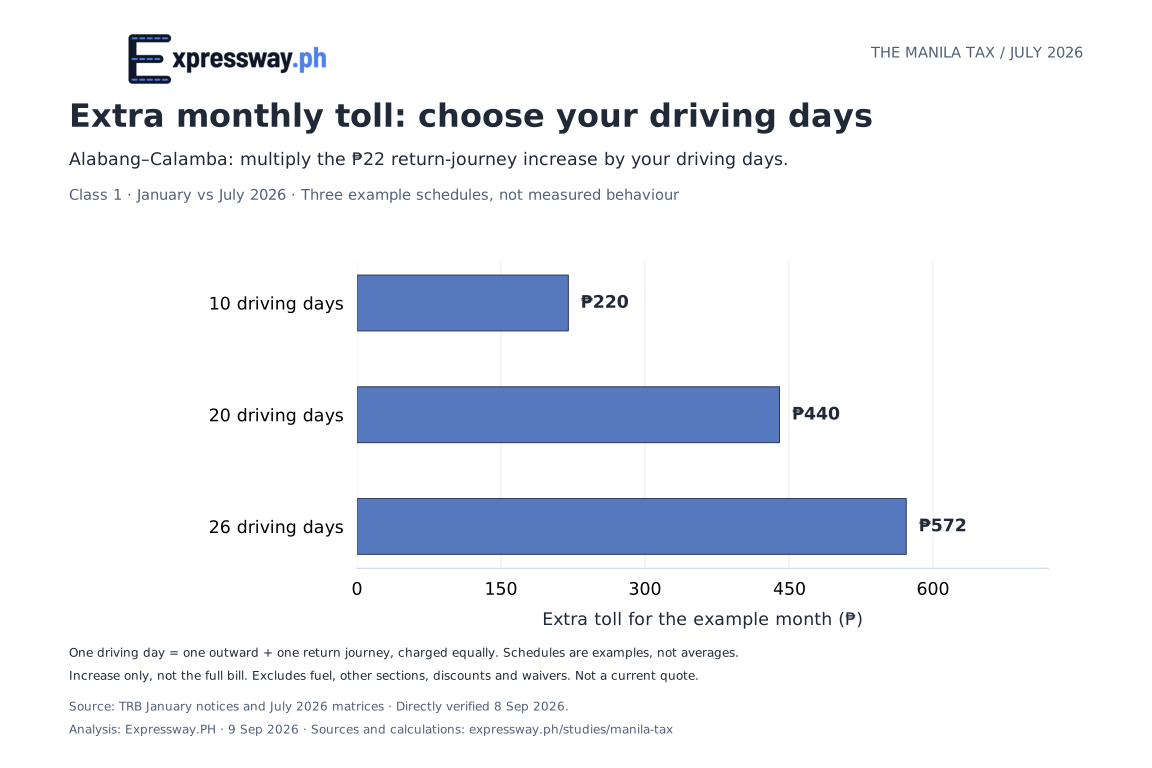
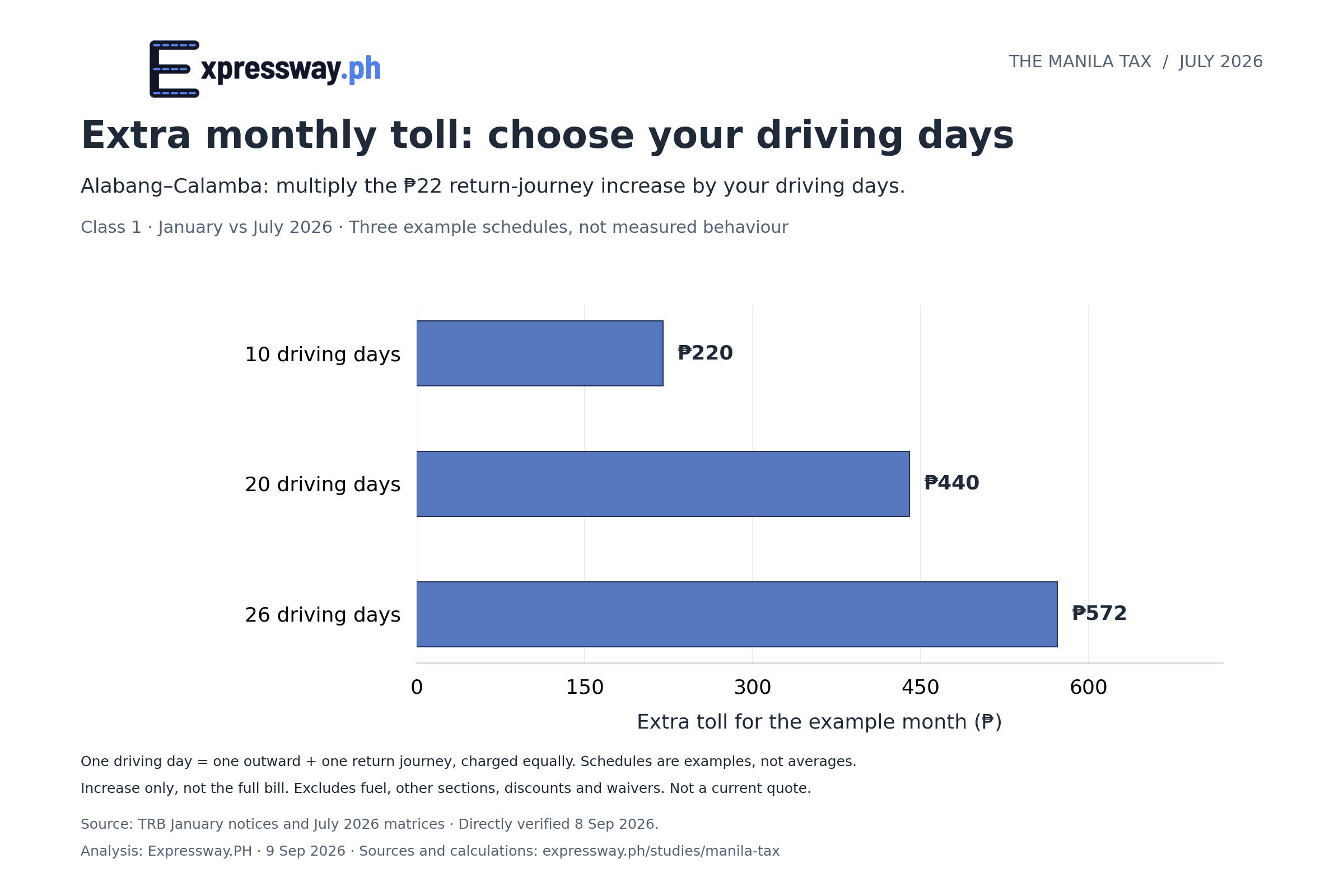
For Alabang–Calamba, 10 return journeys add ₱220; 20 add ₱440; 26 add ₱572. Those are three possible monthly schedules, not claims about how often people commute.
| Segment | January 2026 fare | July tariff | Increase one way |
|---|---|---|---|
| Alabang–Calamba | ₱126 | ₱137 | ₱11 |
| Calamba–Sto. Tomas | ₱34 | ₱37 | ₱3 |
| Sto. Tomas–Lipa | ₱60 | ₱64 | ₱4 |
| Lipa–Batangas City | ₱53 | ₱57 | ₱4 |
Find the four segments in travel order, compare the one-way fares, then follow the Alabang–Calamba example from one journey to a month. This is a route schematic, not a geographic map.
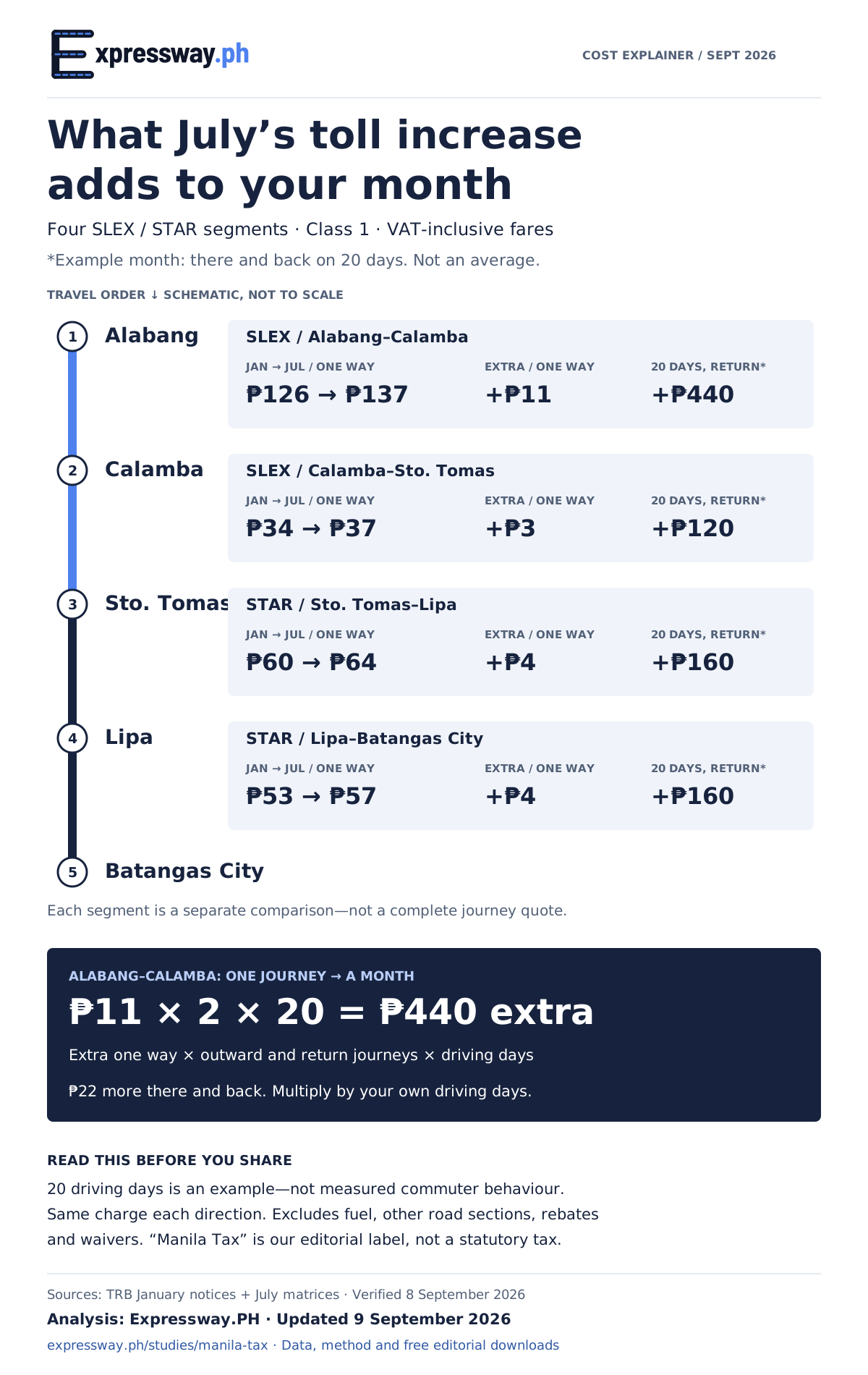
Download vector infographic (SVG)Download high-resolution PNG
Free editorial reuse with Expressway.PH credit and the assumptions preserved. Please link to this study so readers can inspect the data. No followed-link requirement; credit does not imply TRB endorsement.
Copy this image-and-credit block into your article’s HTML. It uses no scripts or tracking. The URLs work after this release is published on Expressway.PH.
It meant 240 days of driving there and back across a hypothetical year: five days a week for 48 weeks, or 20 days a month for 12 months. It did not mean 240 trips in July, and it was not a measured commuter average.
At ₱22 extra per return journey, 240 round trips add ₱5,280. This is an optional fixed-rate annual comparison, not an actual 2026 bill: the increase took effect partway through the year. Use your own driving schedule instead.
Verified against TRB’s official January notices and matrices effective 1 July 2026, directly inspected on 8 September 2026. Both sets of fares are VAT-inclusive and for Class 1. Increases are calculated as July fare minus January fare. The official baseline is not inferred from news reporting.
Extra one-way toll = July fare − January fare. Extra return toll = one-way increase × 2. Extra monthly toll = return increase × your driving days. The 20-day default is illustrative, not an average. No distance, fuel price, wage, rent or journey time enters these calculations. Other sections, discounts, rebates and temporary waivers are excluded.
Version 2026-09-09-monthly-explainer. Results describe the July tariff change, not every later discount or tariff. Check the applicable charge before travelling.
Download calculations (CSV)Download schedule examples (CSV)Download source register (JSON)
“Living in the Philippines for nearly a decade has made transport costs a practical concern for me. With this study, we wanted to answer a specific question: what does a small toll increase mean when you repeat the same journey throughout the year?”
Aditya Aman, Founder of Expressway.PH
Aditya Aman is the founder of Expressway.PH, a website covering Philippine expressways, toll fees and travel planning. A Philippine resident for nearly a decade, he explains the assumptions and calculations behind the website’s “Manila Tax” study.
Press enquiries: aditya@expressway.ph. Editorial reuse of our original charts and derived tables is permitted with clear Expressway.PH credit and the assumptions preserved. This does not cover third-party photographs or graphics.
Download the complete press kit (ZIP)Download the journalist brief
This is a separate question from the toll increase above. It uses your own tolls, distances and fuel inputs to estimate a full annual driving budget. Historical examples are provided only as starting points.
Skyway plaza-to-plaza; local access travel excluded.
₱164 and estimated 20 km inherited from the June 2026 study. Current tariff and distance review pending. Source / verification target
240 is an example, not a measured average. Allow for leave, holidays and remote work. Range: 0–366.
Use your pump price. ₱60 is illustrative, not a current DOE quotation. Range: 0–300.
Use your measured efficiency; traffic, load and vehicle condition can change it. Range: 1–100.
Replace the historical preset with your known Class 1 charge. Range: 0–10000.
Check the return charge separately. Range: 0–10000.
Preset is estimated. Include local access travel if you know it. Range: 0–1000.
The return journey can differ. Range: 0–1000.
Your toll-plus-fuel scenario
₱126,720/year
₱528 per driving day × 240 days
Not a national average or a full ownership budget. Parking, maintenance, depreciation and your time are excluded.
Only annual driving days change. All your other inputs stay fixed.
| Days/year | Total | Less driving expenditure |
|---|---|---|
| 240 | ₱126,720 | ₱0 |
| 216 | ₱114,048 | ₱12,672 |
| 192 | ₱101,376 | ₱25,344 |
48 fewer days corresponds to one fewer driving day over 48 weeks. Replacement travel and home-working costs are excluded: this is not a net-savings estimate.
(164 + 164) + ((20 + 20) ÷ 12 × 60) = ₱528 per driving day. Multiply the unrounded daily result by 240. Displayed peso totals are rounded only at presentation.
01 / Understand the difference
Fixed comparison: 240 driving days · ₱60/L · 12 km/L · historical toll presets and estimated distances, not current quotes.
Blue: tolls · Amber: fuel. Longer bars mean more expenditure, not worse value.
| Route | Tolls/year | Fuel/year | Total/year |
|---|---|---|---|
| Marilao ↔ Balintawak | ₱40,800 | ₱52,800 | ₱93,600 |
| Alabang ↔ Buendia | ₱78,720 | ₱48,000 | ₱126,720 |
| Buendia ↔ Balintawak | ₱126,720 | ₱45,600 | ₱172,320 |
These are different journeys, not competing ways to reach one destination. The chart separates the two costs; it does not rank route quality, time saved or affordability.
02 / Interpret the result
If you stop driving on a particular day, this model removes that day’s toll and fuel. It does not know whether you paid for a bus, worked from home or made another trip instead.
Parking, repairs, insurance, depreciation and the value of your time are outside this calculation. Compare those separately before changing your travel routine.
03 / Inspect the evidence
Model 2026-09-07-draft. Presets below come from the earlier study. Links distinguish corroborating reporting from sources still needing inspection; an official link alone is not verification.
Historical preset: ₱85 each direction; estimated 22 km each direction.
₱85 corroborated in reporting on January 2026 tariffs; 22 km is an inherited estimate. Current primary review pending.
Inspect source / verification targetHistorical preset: ₱164 each direction; estimated 20 km each direction.
₱164 and estimated 20 km inherited from the June 2026 study. Current tariff and distance review pending.
Inspect source / verification targetHistorical preset: ₱264 each direction; estimated 19 km each direction.
₱264 and estimated 19 km inherited from the June 2026 study. Current tariff and distance review pending.
Inspect source / verification targetFuel defaults to an illustrative ₱60/L, not a measured current average. Use your receipt or a dated DOE price observation. Efficiency defaults to an illustrative 12 km/L. Both are editable.
Annual cost = annual driving days × [outbound toll + return toll + (outbound distance + return distance) ÷ km/L × fuel price]. Each driving day contains one outward and one return journey. No inflation or future tariff forecast is applied.
The 240-day default is a scenario, not a calendar or population estimate. The route comparison keeps that default fixed; the calculator uses your entered values. Figures are rounded for display only. Scenario links include the model version and numeric assumptions; they do not collect your address.
This study does not compare rent, wages, holidays or time savings. Toll expenditure alone cannot establish whether moving home, changing jobs or choosing another route would leave you better off.
Check the applicable tariff and your specific journey before travelling.
Open the toll calculator