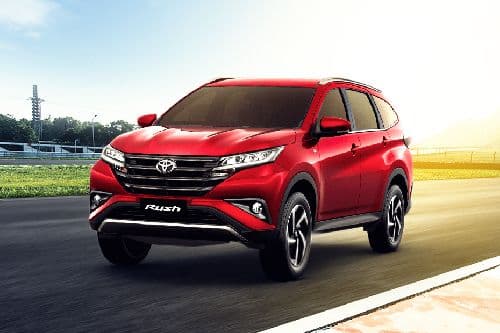
Compact SUV · 2025
Toyota Rush Price Philippines 2026
₱1,014,000 to ₱1,295,000

54
Expressway Score
16
km/L highway
6
Airbags
Class 1
Toll Class
Expressway Score
54/100FAIR
Score Breakdown
Overview
The 2025 Toyota Rush is a compact, body-on-frame SUV that offers genuine 7-seat versatility at an accessible price point. Powered by a 1.5L 2NR-VE engine producing 103 hp and 136 Nm, the Rush prioritizes practicality and durability over outright performance. The Toyota Rush price Philippines range of ₱1,014,000 to ₱1,295,000 positions it as a more affordable alternative to the Toyota Fortuner for families who need space and ground clearance without the premium price. Its body-on-frame construction, shared with the Daihatsu Terios, delivers ruggedness that monocoque rivals cannot match on rough Philippine roads. The GR-S variant adds sporty exterior styling, a push-start button, and a 9-inch touchscreen, though it still lacks ADAS features available on competitors like the Honda BR-V. The Rush remains a strong seller in the Philippines because of its combination of Toyota reliability, 7-seat capacity, commanding 220mm ground clearance, and strong resale value.
This overview is AI-assisted based on manufacturer specifications and Philippine market data. Specs and pricing are sourced from official dealership listings. Editorial Policy
Expressway Driving Review
The Toyota Rush manages expressway driving acceptably but reveals its limitations at sustained highway speeds. The 1.5L engine with just 103 hp and 136 Nm requires the driver to plan overtaking maneuvers well in advance, building speed before changing lanes is essential, especially when carrying a full load of 7 passengers. The 4-speed automatic transmission on the G and GR-S variants is the Rush's biggest expressway weakness: it hunts between gears at 80-90 km/h, and the limited gear spread means higher engine RPM and more noise at cruising speed compared to CVT or 6-speed rivals. NVH is noticeably higher than monocoque competitors like the Honda BR-V or Toyota Veloz, the body-on-frame construction and tall, flat-sided profile create both structural and wind noise above 100 km/h. Highway fuel efficiency of 14-16 km/L is acceptable but trails the Raize's 21 km/L by a significant margin. The 220mm ground clearance is genuinely useful for rough toll plaza transitions and expressway construction zones. The complete absence of cruise control and ADAS on all variants means the driver bears full responsibility for speed management, increasing fatigue on 3+ hour drives via NLEX-SCTEX-TPLEX. As a Class 1 vehicle, toll costs are standard. Compared to the Honda BR-V, the Rush is less refined on the highway but more durable for rough-road use.
This review is AI-assisted based on manufacturer specifications and Philippine market data. Specs and pricing are sourced from official dealership listings. Editorial Policy
Driver Assistance Features
Toyota Rush 2025 Price & Variants
| Variant | Price | Transmission | Fuel |
|---|---|---|---|
| 1.5 E MT | ₱1,014,000 | MT | gasoline |
| 1.5 G AT | ₱1,195,000 | AT | gasoline |
| 1.5 GR-S AT | ₱1,295,000 | AT | gasoline |
Specifications
Engine & Performance
- Displacement
- 1,496 cc
- Power
- 103 hp @ 6,000 rpm
- Torque
- 136 Nm @ 4,200 rpm
- Transmission
- 5MT / 4AT
- Fuel Type
- gasoline
Dimensions
- Length × Width × Height
- 4435 × 1695 × 1705 mm
- Wheelbase
- 2685 mm
- Ground Clearance
- 220 mm
- Kerb Weight
- 1,200 kg
- Trunk Capacity
- 205L
Fuel Efficiency
16
km/L Highway
10
km/L City
Pros & Cons for Expressway Driving
Pros
- ✓220mm ground clearance, highest in the compact SUV segment
- ✓Body-on-frame durability handles rough roads better than monocoque rivals
- ✓Genuine 7-seat layout for families
- ✓Strong Toyota resale value, retains 75%+ after 3 years
- ✓Affordable starting price under ₱1.1M for a 7-seat SUV
- ✓Manual transmission option available for those who prefer it
- ✓Low maintenance costs at Toyota's 70+ nationwide dealers
Cons
- ✗No ADAS features on any variant (no AEB, no cruise control, no lane keep)
- ✗4-speed automatic is outdated, causes gear hunting on expressways
- ✗Noisy cabin at highway speeds due to body-on-frame construction
- ✗103 hp feels underpowered when carrying 7 passengers on inclines
- ✗205L trunk is small with 3rd row up, limits luggage for road trips
- ✗Interior materials feel dated compared to monocoque rivals like BR-V
This analysis is AI-assisted based on manufacturer specifications and Philippine market data. Specs and pricing are sourced from official dealership listings. Editorial Policy
What 100 km costs in the Rush this week
At 16 km/L on the highway and this week's DOE Metro Manila price of ₱85.70 per liter of Unleaded 95 (week of September 8 to 14, 2026).
Per 100 km
₱536
Manila to Baguio (250 km)
₱1,339
Per km
₱5.36
Work out your own trip or see this week's prices by brand and city.