Suzuki Jimny vs Toyota Rush: Philippines 2026 Comparison

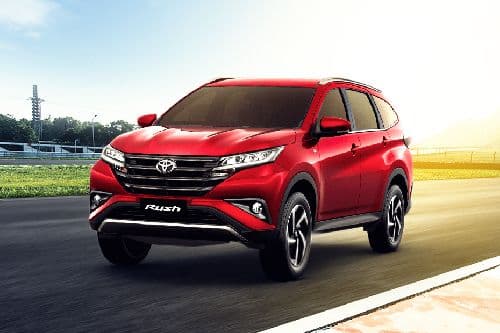
Quick Verdict
The Toyota Rush edges out the Suzuki Jimny with better highway fuel efficiency (16 vs 14 km/L) and a higher Expressway Score (54 vs 47).
Expressway Score Comparison
Suzuki Jimny
47
FAIR
Toyota Rush
54
FAIR
Score Breakdown
| Category | Suzuki Jimny | Toyota Rush |
|---|---|---|
| Highway Fuel | ★★★★★14 km/L | ★★★★★16 km/L |
| Highway Comfort | ★★★★★ | ★★★★★ |
| Safety (ADAS) | ★★★★★4 airbags | ★★★★★6 airbags |
| Cargo Space | ★★★★★85L | ★★★★★205L |
Key Specs: Suzuki Jimny vs Toyota Rush
| Spec | Suzuki Jimny | Toyota Rush |
|---|---|---|
| Price Range | ₱1,195,000 — ₱1,345,000 | ₱1,014,000 — ₱1,295,000 |
| Expressway Score | 47/100 | 54/100 |
| Highway Fuel | 14 km/L | 16 km/L |
| City Fuel | 9 km/L | 10 km/L |
| Engine | 1,462 cc | 1,496 cc |
| Power | 100 hp @ 6,000 rpm | 103 hp @ 6,000 rpm |
| Torque | 130 Nm @ 4,000 rpm | 136 Nm @ 4,200 rpm |
| Transmission | 5MT / 4AT | 5MT / 4AT |
| Airbags | 4 | 6 |
| Cruise Control | None | None |
| Adaptive Cruise | No | No |
| Lane Keep Assist | No | No |
| Auto Emergency Braking | No | No |
| Trunk Capacity | 85L | 205L |
| Ground Clearance | 210 mm | 220 mm |
| Kerb Weight | 1,095 kg | 1,200 kg |
| Toll Class | Class 1 | Class 1 |
Monthly Fuel Cost Comparison
Based on a typical NLEX commute: 90 km/day x 20 working days = 1,800 km/month at ₱65.45/L gasoline.
Suzuki Jimny
14 km/L highway
₱8,415
per month
Toyota Rush
16 km/L highway
₱7,363
per month
The Toyota Rush saves you approximately ₱1,052/month (₱12,624/year) on expressway fuel.
Pros & Cons
Suzuki Jimny
Pros
- ✓Genuine part-time 4WD with low-range transfer case for off-road capability
- ✓210mm ground clearance handles any flood or speed bump scenario
- ✓Exceptional resale value retaining 85-90% after 3 years in PH
- ✓Compact 3,645mm length makes parking and U-turns at toll plazas effortless
- ✓Ladder-frame chassis provides rugged durability over 200,000+ km
- ✓Iconic retro design commands attention and strong community following
- ✓4 airbags standard across all variants for basic safety coverage
Cons
- ✗No cruise control or ADAS on any variant — full manual driving required
- ✗85-liter trunk is the smallest in the SUV segment for expressway road trips
- ✗4-speed automatic is outdated and limits fuel efficiency on NLEX/SLEX
- ✗Short 2,250mm wheelbase creates instability above 100 kph on expressways
- ✗Significant wind and road noise above 80 kph due to boxy body profile
- ✗Only 100 hp limits overtaking confidence on uphill SLEX and Skyway sections
Toyota Rush
Pros
- ✓220mm ground clearance — highest in the compact SUV segment
- ✓Body-on-frame durability handles rough roads better than monocoque rivals
- ✓Genuine 7-seat layout for families
- ✓Strong Toyota resale value — retains 75%+ after 3 years
- ✓Affordable starting price under ₱1.1M for a 7-seat SUV
- ✓Manual transmission option available for those who prefer it
- ✓Low maintenance costs at Toyota's 70+ nationwide dealers
Cons
- ✗No ADAS features on any variant (no AEB, no cruise control, no lane keep)
- ✗4-speed automatic is outdated — causes gear hunting on expressways
- ✗Noisy cabin at highway speeds due to body-on-frame construction
- ✗103 hp feels underpowered when carrying 7 passengers on inclines
- ✗205L trunk is small with 3rd row up — limits luggage for road trips
- ✗Interior materials feel dated compared to monocoque rivals like BR-V
Other Comparisons
Suzuki Jimny vs Toyota Rush FAQ
Which is cheaper, Suzuki Jimny or Toyota Rush?
The Toyota Rush is more affordable, starting at ₱1,014,000 compared to ₱1,195,000 for the Suzuki Jimny. That is a difference of ₱181,000.
Which has better expressway performance, Suzuki Jimny or Toyota Rush?
The Toyota Rush has a higher Expressway Score of 54/100 compared to 47/100 for the Suzuki Jimny. This factors in highway fuel efficiency, comfort, safety features, toll class, cargo space, and cruise control.
Which is more fuel-efficient on highways, Suzuki Jimny or Toyota Rush?
The Toyota Rush is more fuel-efficient on expressways at 16 km/L compared to 14 km/L for the Suzuki Jimny. For a typical NLEX commute of 90 km/day, the Toyota Rush saves you approximately ₱1,052/month on fuel.