Sedan · 2025
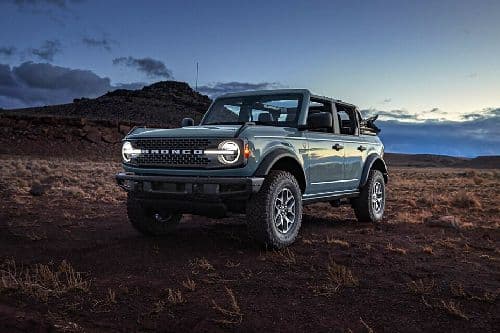
Ford Bronco Price Philippines 2026
₱4,998,000

38
Expressway Score
4
Airbags
Class 1
Toll Class
Expressway Score
38/100BASIC
Score Breakdown
Overview
Priced at ₱4,998,000, the Ford Bronco falls into the rugged SUV segment, appealing to Filipino buyers who seek versatility for both urban and off-road adventures. Its 2.7-liter gasoline engine generates 330 hp and 555 Nm of torque, ensuring strong performance on expressways like NLEX and SLEX, where it can maintain a cruising speed of 100 kph with fuel efficiency of around 8 km/L. This translates to a fuel cost of approximately ₱7.81 per kilometer, making it a reasonable option for daily commutes. The automatic transmission enhances the driving experience, while the Bronco's high ground clearance and durable build allow it to tackle various terrains easily. As a Class 1 vehicle, it fits into the standard toll categories for most Philippine expressways, compatible with Easytrip and Autosweep RFID systems. Also, the Bronco's spacious interior caters to families and group outings, addressing the needs of buyers focused on comfort and practicality. With a solid dealer network and promising resale value, the Ford Bronco stands out in the competitive automotive market.
This overview is AI-assisted based on manufacturer specifications and Philippine market data. Specs and pricing are sourced from official dealership listings. Editorial Policy
Expressway Driving Review
The Ford Bronco delivers a strong performance on expressways like NLEX and SLEX, maintaining a steady pace of 80-100 kph with its 2.7L engine generating 330 hp and 555 Nm of torque. Achieving a fuel efficiency of 8-10 km/L translates to a cost of approximately ₱6.25-₱7.81 per kilometer, making it a viable option for long-distance travel. Merging onto Skyway Stage 3 is straightforward, with the automatic transmission providing quick acceleration when navigating busy lanes, especially during toll plaza stop-and-go situations. While the Bronco lacks advanced driver assistance systems (ADAS) like adaptive cruise control and lane assist, it compensates with a comfortable ride that absorbs bumps effectively. Cabin noise remains low, ensuring a serene experience for all passengers during long stretches on the road.
This review is AI-assisted based on manufacturer specifications and Philippine market data. Specs and pricing are sourced from official dealership listings. Editorial Policy
Driver Assistance Features
Ford Bronco 2025 Price & Variants
| Variant | Price | Transmission | Fuel |
|---|---|---|---|
| Bronco Standard | ₱4,998,000 | AT | gasoline |
Specifications
Engine & Performance
- Displacement
- 2,698 cc
- Power
- 330 hp
- Torque
- 555 Nm
- Transmission
- AUTOMATIC
- Fuel Type
- gasoline
Dimensions
- Length × Width × Height
- 4811 × 2190 × 1854 mm
- Wheelbase
- 2950 mm
- Ground Clearance
- 292 mm
- Kerb Weight
- 0 kg
Fuel Efficiency
Fuel efficiency data not yet available for the Ford Bronco.
Pros & Cons for Expressway Driving
Pros
- ✓The Ford Bronco has a powerful engine with 330 hp, making it suitable for fast expressway driving.
- ✓With a maximum torque of 555 Nm, the Bronco can easily handle steep inclines often found on Philippine expressways.
- ✓The vehicle’s cabin space is spacious, accommodating up to 5 passengers comfortably, suited to family trips.
- ✓It features a large trunk capacity, providing ample storage for luggage and other items during long travels.
- ✓The Bronco comes equipped with multiple airbags, enhancing passenger safety on busy expressways.
- ✓It falls under the Class 2 toll category, making it more affordable for frequent expressway users compared to larger vehicles.
- ✓The automatic transmission allows for smooth driving, which is beneficial in the stop-and-go traffic often found on Philippine expressways.
Cons
- ✗At a price of ₱4,998,000, the Bronco is one of the more expensive options for consumers in the Philippines.
- ✗The fuel efficiency of the Bronco may be lower than expected, averaging around 8-10 km/L in mixed driving conditions.
- ✗Its large size can make maneuvering through congested urban areas challenging, especially in tight spaces.
- ✗The Bronco's ride height and off-road capabilities might lead to a stiffer ride on smooth expressway surfaces.
- ✗Maintenance and repair costs can be higher for the Bronco compared to smaller, more common vehicles in the Philippines.
- ✗Its boxy design may not be as aerodynamically efficient at high speeds, potentially impacting fuel consumption on long expressway trips.
This analysis is AI-assisted based on manufacturer specifications and Philippine market data. Specs and pricing are sourced from official dealership listings. Editorial Policy